Student animation blog which discusses the process implemented in the creation of projects and the idea and thoughts that have evolved through them. [To be continued as a personal animation project blog.]
For this week we didn't have the studio, so we where moved upstairs to an empty room. This lesson focused on drawing heads and faces from various angles. We began with a twenty minute portrait of our model which we had to then assess ourselves for quality (I gave myself a six) as well as likeness (also a six) as a mark out of ten. It wasn't the best portraiture I have ever done.
After which, we had to draw the outline of each side of his head, the "coast line" as it were. It looks a bit like a weird echo.
Following this, we did five minute drawings as he turned around the circle. This way we could record the face and head from various angles, which is a nice reference to have when animating head movement; to have an immediate example of how it turns. These five minute drawings were then shortened to four.
Lastly, we did pen drawings ranging from three minutes down to 10 seconds. It was intense, to say the least.
Week five brought the return of life drawing. To begin, we did a solid 15 minute pose to get back in the swing of things. This was followed by a series of five minute pen drawings using various techniques: with the left hand, the right hand, holding the pen with two fingers, holding the pen at the top etc. It was very interesting drawing like this.
Following this, we did two charcoal light silhouettes where we coloured the pages black, then took away from where the light hit the body. Also, we did a charcoal sketch and finished with quick sketches of the model moving around the room.
This week, we left the studio and instead held drawing class at the Royal Armouries. We were to pick two distinct ages in history, and draw armour from those times. The intention behind this was to "dress up" the life models in them and create an army of some kind later on in the semester.
I chose to draw from the 16th/17th century europe collection...
Against the samurai era....
After compiling the sketches together, I can see that I need to make a few more. Particularly, I will look at drawing the pieces from varying angles for a fuller view and better understanding of the items.
Having missed weeks one and two due to confusion of what time class was on, I finally managed to make it three weeks in.
I was impressed by what I saw was done the week before, and so I did not want to miss another week of drawing class. The creation of a bizarre cityscape was devoid of characters, thus we had to make some and decide who they were and were they would go in the picture.
I created two characters, the clown and the dazed minister, who probably has mental health issues. The clown is actually his carer, and as they are going to the carnival over the hill, he has dressed up to meet the demands of his patient. Though, I should have done rotational profile drawings of the characters.
On the way, he is posting a letter to his family. A post card, to be precise. it is from this position next to the post box at the edge of the lake that I fulfilled the next aspect of the class: to draw the environment of the cityscape through the eyes of our character.
With firearms first developed in China, hand held cannons as well as ground cannons were soon born. Through either the Silk Road or the Mongol invasion during the 13th century, gunpowder and it's weaponry were brought to Europe.
Eventually, the matchlock musket comes to be in the 15th century, after the technology has been refined from a completely human operated system, to one which is mechanical. This is similar to one that I intend to use.
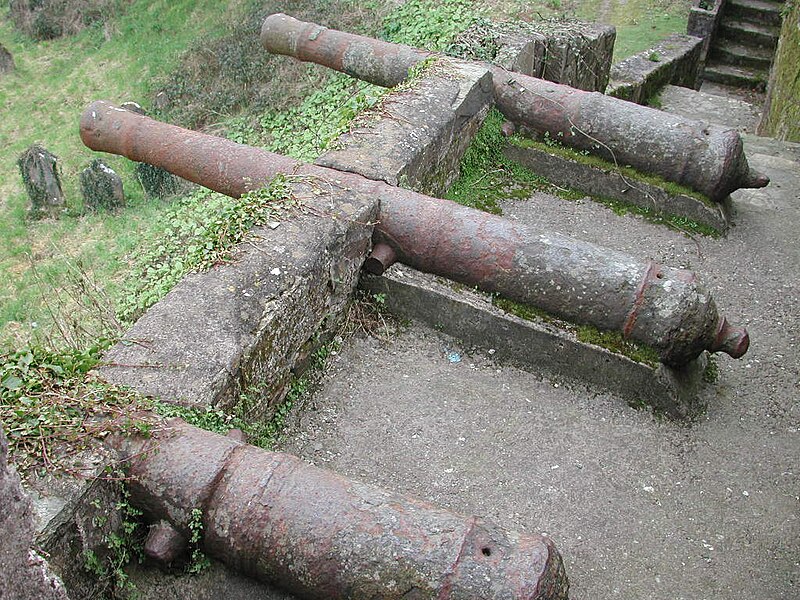
With firearms first developed in China, hand held cannons as well as ground cannons were soon born. Through either the Silk Road or the Mongol invasion during the 13th century, gunpowder and it's weaponry were brought to Europe.
16th century cannon; http://www.fotothing.com
http://en.wikipedia.org
Among the most recognizable of the ground cannons developed, was the 16th-18th century cannon. Though it has not changed much from the earliest recorded English cannon of 1327, all that seems to have changed is that they then came with wheels.
Granted, early models were smaller; however they tended to fire arrows or other ammunition and are not exactly what would be definitively recognisable as being a cannon. Such models of the the inbetween progression staged include the 'ribauldequin', the 'ribaldis' and the 'grapeshot'.
Alas, though cannons were a great asset in wars and a development that stayed around for many centuries, it was not until 1716 under King George I that a permanent unit was formed specialising in the operation of a cannon. Previous to this time, units were formed specifically for a war and disbanded afterwards.
As such, I have chosen to model my puppet's outfit after this time, as it frustrated me as to what he would wear to accurately depict the time of the weapon. Aware that each segment of an army is kitted out differently, with huge ranges of difference such as between a pikeman and a cavalier, I was a ware that if I got it wrong, it would look quite bizarre. As such, the compromise on this is that a unit that normally comprises of around 5 personnel, for the sake of this animation I have reduced it to just the one person.
http://www.thegarrison.org.uk/history/index.php
With the outfit finally sorted after much research, I then had to animate it. So, what is the process of firing a cannon, how can I replicate it with a singular person in place of a properly manned military unit? After looking at this video below, I was able to emulate the process a little, along with some effective transitioning to aid in the preparation of the load-fire sequence. Further, as the character then disappears off screen, where the other half of the cannon itself is and we cannot see the ignition, merely a suggestion of the actual process to firing. I think this might be okay, as the focus of this is more on the progression of projectile weaponry as opposed to how the mechanic behind each phase has developed through time.
I realised that despite my animation being like "Geri's Game", I had ended up nearly explaining how each and every item was operated before firing, much like in the beginning of the short we see Geri pondering over a move both as an opponent and himself. To allow for build in tension, this is only at the beginning, which I was ignoring, leading to my overall progress to seem a bit...flat. As such, my patience running thin on animating it as such (with no rise toward the end) led me to cutting out those parts for the final weapons, leaving just the
It was only a good thing that I realised this, as it meant that not only did my animation look better, but what I had left to animate got a better share of my time. Clearly, I seem to be getting distracted and putting in everything of the story, instead of purely the pieces that are necessary. I have to be really careful, or my stories will end up a bit too linear, and that I would assume is as tedious and un-engaging to watch as it is to plod through the making.
After showing my animatic in conjunction with my work-in-progress, I got my feedback, which for ages I had no idea on how I was going to change what I had in order to take on board the rather divided opinions. Finally, I had an idea, that would both keep the original concept which some thought was fine, but also give it that little bit more as was wanted.
Thus, I decided that instead of simply an evolution morph (which turned into a fade upgrade) I should have the "spirit" of the last of the war items as landing on the javelin to be thrown, thus the sport inherits its essence in friendly competition.
Well. I couldn't find the very first spear ever crafted, but I did manage to get a reference of some early spears and how they were fashioned; of flint tied onto a long, thin piece of wood. I managed to find this picture, on the internet (I think) which I relied on heavily as reference material.
mesa verde spear & knife
As for getting the movement right, I decided to use this video as a guide.
Surrounding the bow and arrow, there is a shroud of mystery. When, exactly, was it first created? A mystery that has bothered me also, for I would like to depict the earliest, if not the first, likeness within my animation. If I had been around 64-8000 BC I would not have this problem. Regardless, I have ended up going for a slightly generic depiction.
http://imnh.isu.edu
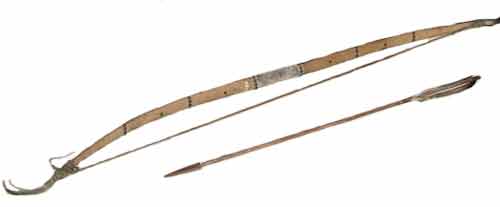
I quite liked how this one's bow string is tied. However, it is quite recent, dated as being adopted in southern Idaho around 500 AD. Most early arrows wouldn't have had any kind of fletching, either.
http://www.10millionmiles.com/
I like that this one has no fletching on the arrow, as well as how rough and plain the bow itself is. However, I don't know if this is just a made up drawing as the site it was uploaded from is inaccessible.
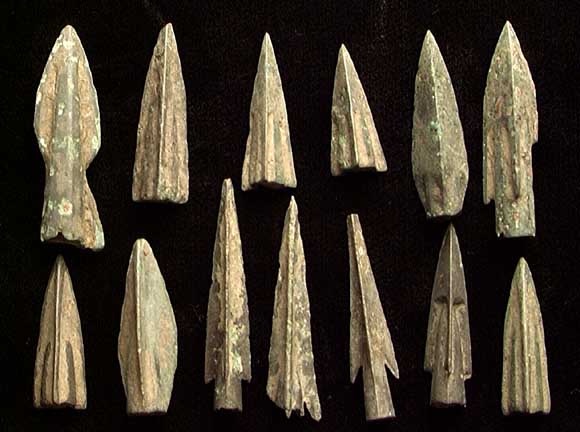
After some searching, I also looked at some arrow heads, but decided these were too advanced...
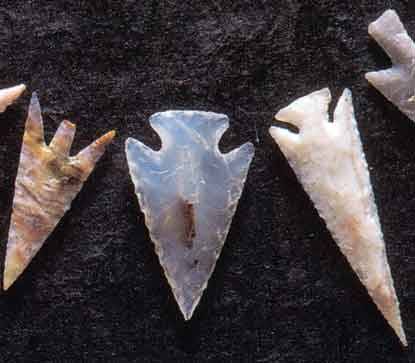
I think something closer to this would have been far more likely.